
One Year On: Glenelg Golf Club Biochar Trial Update
High‑quality playing surfaces and true‑rolling greens that stay resilient through summer stress are every golfer’s dream. For golf course managers, the challenge is delivering those conditions year after year, even as weather becomes more variable.
More than 12 months after incorporation, and after a hot, dry summer in 2025/26, we checked in with Tim Warren, Course Superintendent at Glenelg Golf Club, to review the performance of the Terix Biochar greens trial.
While the initial trial focused on early root development and moisture dynamics, this follow‑up looks at how the treated greens performed under normal course management and seasonal stress over the 12 month period.
Trial at a glance
Control: Greens 10 and 17 received the standard amendments used across the course.
Trial: Greens 6 and 7 received the same amendments plus Terix Biochar at approximately 120 kg/100 m².
Amendments were rotary‑hoed into the profile to a depth of 100 mm before final floating and turfing.
What the team observed after 12+ months:
Root depth and density: Greens 6 and 7 treated with biochar showed visually greater root depth and density than the control greens.
Summer resilience: The biochar‑treated greens maintained a good degree of resilience through the warm, dry summer months, supporting consistent playing surfaces under stress.
Longer‑term benefits: Over time, the treated surfaces have reinforced how biochar can support moisture retention, higher CEC, nutrient‑holding capacity and overall resilience when managed as part of a standard turf program.
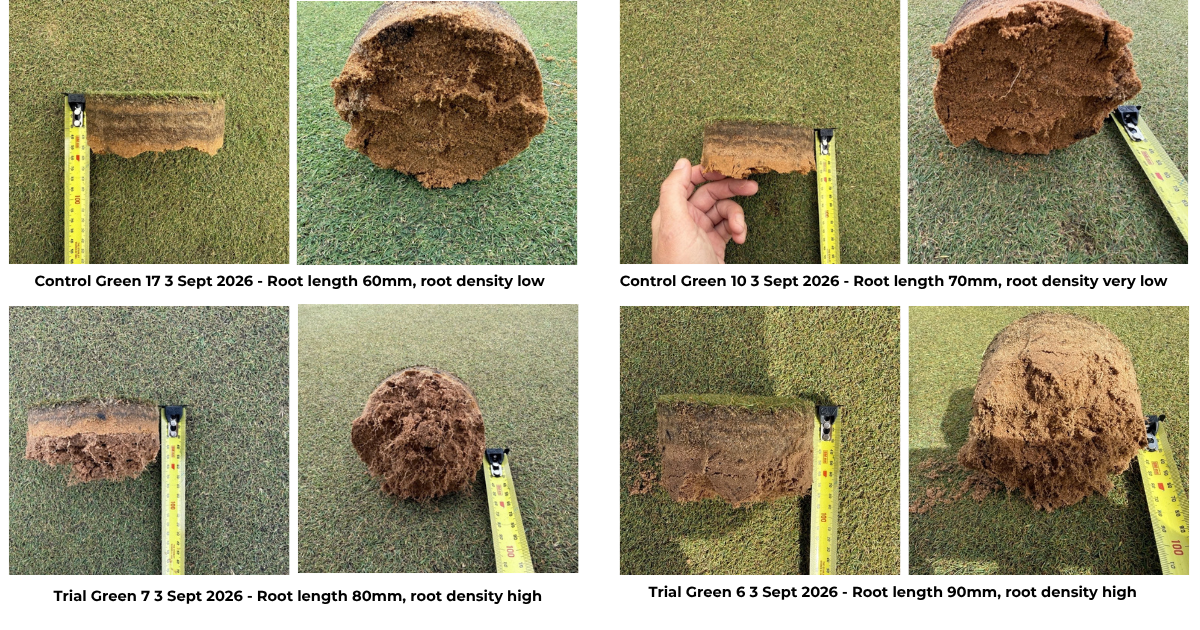
“After more than 12 months, the biochar treated greens continue to show better root depth and density than our control greens, and they’ve handled a tough summer well. That longer term performance is what gives us confidence to keep using biochar in our turf program.”
Next steps: Sand injection program
Building on these results, Glenelg GC will extend biochar use through a sand injection program to create channels of sand/biochar in the profile and further encourage root depth and density. For this part of the trial, Glenelg will use the Fertec Entra Mini (0.5–2 mm) 90:10 gypsum:biochar granule, incorporating Terix Biochar from Pyrocal.
First injection: end of November.
Planned application: 2 tonnes per 500 m², including 10% 90:10 gypsum:biochar granule by volume.
Higher biochar inclusion levels are considered desirable and will be explored in future programs.
Biochar performance at Glenelg GC so far
Pyrocal initially supplied their fine grade Terix Pecan Nutshell Biochar in bulk bags. After more than 12 months in the ground, the Glenelg trial indicates that incorporating Terix Biochar into greens construction can:
Improve root system development, with greater root depth and density compared with standard amendments.
Support surface resilience under warm, dry conditions, helping maintain consistent playing quality through stress periods.
Contribute to longer‑term soil function, including moisture retention, higher CEC and nutrient‑holding capacity, within a normal turf management program.
Together with the planned sand injection program, these results suggest biochar can play a practical, performance‑led role in high‑end turf construction and ongoing greens management.
Better surfaces so your golfers keep coming back season after season
For Glenelg’s avid golfers, this means firmer, more resilient greens that hold shots, roll true and stay consistent through heat and dry spells.
For other turf managers, the Glenelg trial shows how biochar supports stronger roots, better moisture and nutrient management, and longer-term surface resilience.
If you’re interested in trialling a similar approach on your greens, tees or sports surfaces, contact the Pyrocal team to discuss your options.