
According to the International Biochar Initiative’s Global Biochar Market Report, there’s been a notable shift in the global market.
Global production is accelerating: Estimated production increased from 180,150 metric tonnes in 2023 to 520,810 metric tonnes in 2025 – an approximate 70% CAGR.
Producers expect further scale-up: Industry respondents forecast global output could reach 3.5 million tonnes by 2027 and nearly 9.3 million tonnes by 2030.
The market is maturing: As production scales, the focus is moving beyond initial trials to the practical requirements of commercial adoption.
The Australian Biochar Market is also growing steadily and Terix Biochar Product and Business Development Manager Johann Lombard owes rapid growth in demand to:
Rising confidence in biochar and notably high-quality Terix Biochar
Stronger awareness of its performance
Growing demand for engineered custom blends
A clear preference for locally supplied, technically supported solutions
Highlights
70% global CAGR (2023–2025): Estimated biochar production rose from 180,150 to 520,810 metric tonnes worldwide.
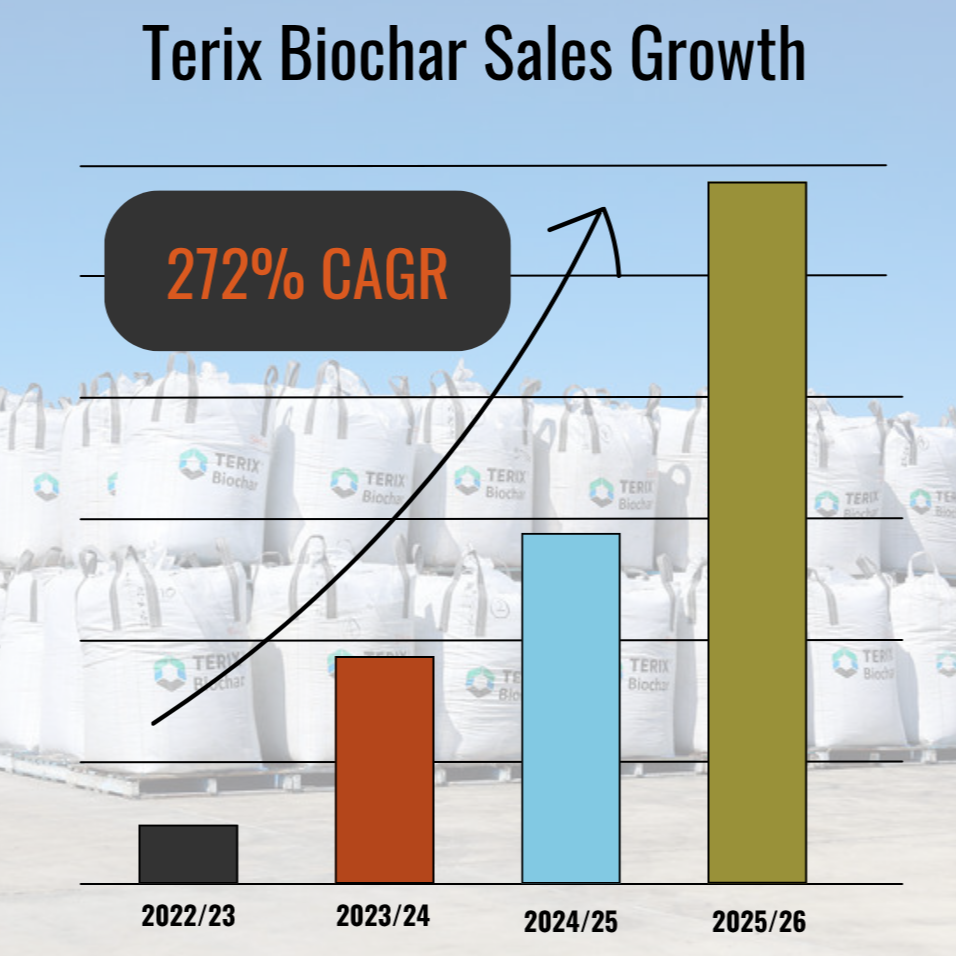
272% CAGR: Terix Biochar sales have grown at a 272% compound annual growth rate from 2022/23 to 2025/26.
Broad-based demand: Growth across retail, wholesale feed, soil and growing-media blends, and industrial applications.
Local focus: Customers prioritise Australian products for local applications to reduce risk of relying on imported products like coir, peat, perlite and imported biochar.
Engineered solutions: Rising demand for consistent, single-feedstock biochar and custom blends for specific projects.
Next challenge: Expanding and securing reliable, specification-grade supply to support continued growth.
End-use focus: Customers increasingly want biochar with clear performance characteristics, application guidance and a dependable supply pathway.
Who’s buying biochar?
According to Johann, all sectors are growing from retail and wholesale feed to soil, growing-media blends and industrial applications.
Customers are using biochar to:
Differentiate their products (potting mixes, soil blends, feed, turf solutions).
Substitute imported or less sustainable inputs with an Australian, environmentally friendly alternative.
Add functional benefits such as moisture management, nutrient efficiency and resilience, while supporting circular-economy objectives.
Support a more local and resilient supply chain by reducing reliance on imported materials and long-distance supply routes.
Industrial applications are also gaining traction, including low-carbon infrastructure work such as the C-Twelve and Hiway low-carbon road projects in New South Wales and the Northern Territory, where biochar was used to support more sustainable construction materials and ground engineering solutions.
Why buyers are choosing engineered biochar
According to Johann, customers are seeking engineered biochar that fits their specific use case.
Key drivers include:
Performance: Biochar is evaluated alongside other inputs on its ability to improve product performance and agronomic outcomes.
Supply security: Buyers want to reduce exposure to overseas supply interruptions and quality variability.
Local technical support: Access to a supplier who can help with specifications, blends and application guidance matters as much as price.
“Returning customers are coming back with increased requirements, alongside new customers and new applications,” Lombard said.
"They need suppliers who can deliver consistent, specification-grade biochar on time, with technical support, at a cost that makes sense in their formulation or program.
Expanding supply to meet demand
The next challenge for the Australian biochar market is expanding reliable supply to support continued growth, new customers and new applications.
“Our focus for the next 12 months is expanding our supply to support the continued growth, new customers and applications,” Johann said.
For businesses considering biochar it’s important to have access to specification-grade, locally produced biochar as demand grows.
“This will increasingly depend on early engagement and longer-term supply planning,” commented Johann.
Lets talk about brilliant biochar and how it can work for your operation or project.
Whether you’re a formulator, grower, turf manager or industrial user, we have a solution for your use case. Contact our team today to discuss your requirements and options.